

Healthcare · Unit-dose dispensing
Every dose, from the pharmacy to the bedside, traced
UDINI automates therapy preparation in hospitals. In the pharmacy one machine cuts blisters into labelled single doses; on the ward another places them in patients’ pillboxes following the hospital’s prescriptions. A single back-office runs orders, stock, recalls and replenishment.
- Product
- UDINI · Medical Dispensing Innovation
- Sector
- Hospital pharmacy and wards
- Machines
- UPoint in the pharmacy, DPoint on the ward
- Languages
- Italian, English, French
At a glance
- connected machines: UPoint in the pharmacy, DPoint on the ward
- 2
- connected machines: UPoint in the pharmacy, DPoint on the ward
- loading bays on the UPoint
- 3
- loading bays on the UPoint
- continuous exchange with the hospital information system
- HL7
- continuous exchange with the hospital information system
- tracked states for every single dose
- 6
- tracked states for every single dose
The challenge
Therapies prepared by hand, tablet by tablet
In many hospitals therapies are still prepared by hand, ward by ward: tablets are pushed out of blisters, counted and placed in patient containers. It is slow, repetitive work where a wrong drug or dose is always possible. And once out of its blister a tablet loses its batch and expiry: nobody can say where it came from or who received it.
The solution
Pharmacy, wards and hospital on one system
With UDINI the pharmacy and the wards share one system, connected to the hospital’s prescriptions. In the pharmacy the UPoint cuts and labels every dose; on the ward the DPoint fills each patient’s pillbox by time slot. Every dose keeps its batch and expiry from blister to patient, and the hospital gets the dispensing outcome back.
How it works
From prescription to pillbox, in six steps
01Prescriptions from the hospital
Drugs, patients and therapies arrive automatically from the hospital system.
02Planning
Every hour the system works out what to produce and what each ward needs.
03Cutting in the pharmacy
The UPoint cuts the blisters, labels each dose and stores it in a UBox.
04Delivery to the ward
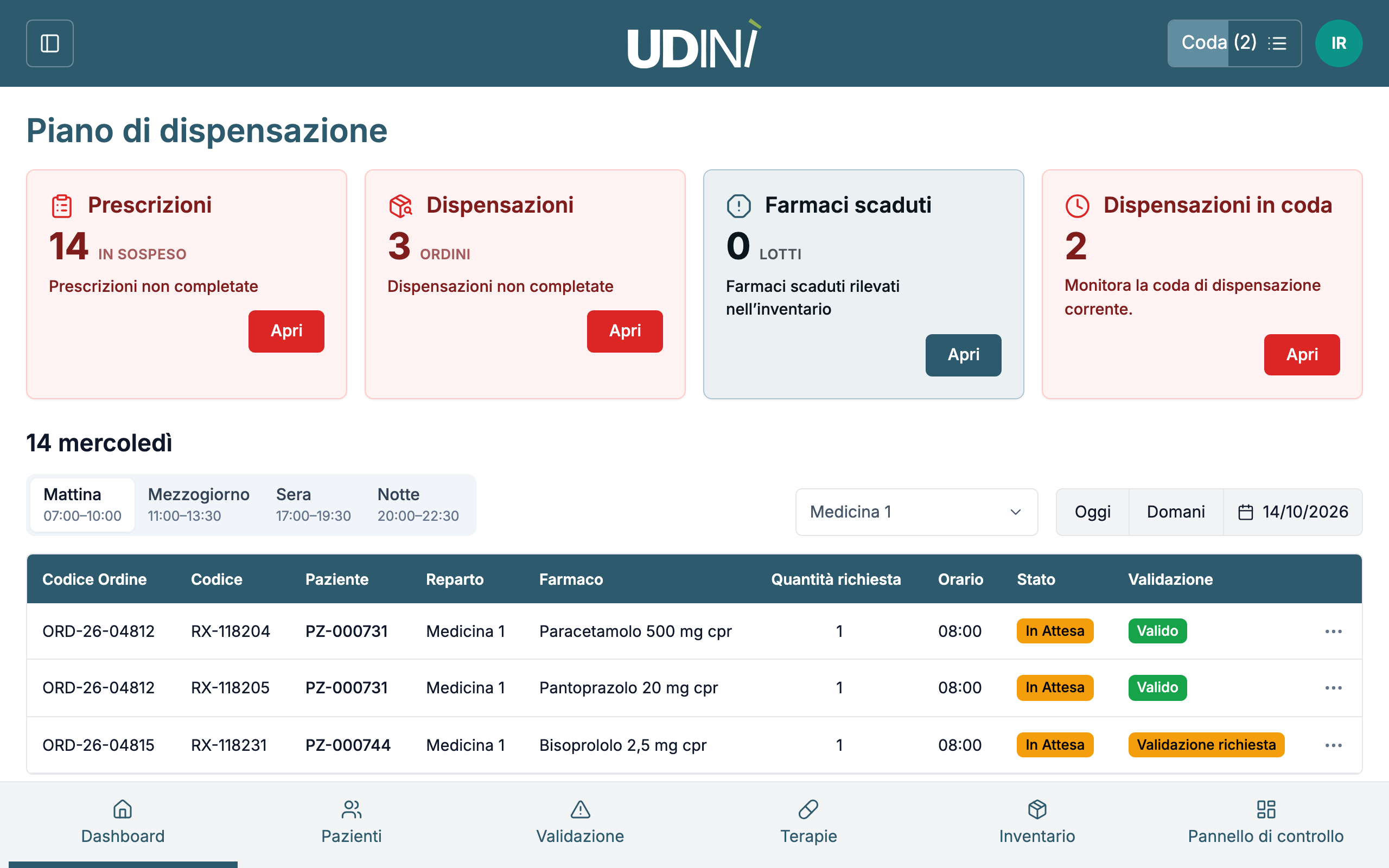
Orders move from Ready to Sent to Received; the UBoxes are loaded into the DPoint.
05Therapy preparation
The DPoint fills each patient’s pillbox with the doses for the time slot.
06Confirmation and traceability
The nurse confirms, the dose is marked used and the hospital is notified.
Two machines, one path
Cutting in the pharmacy, dispensing on the ward
Both machines have a touch interface designed for the people using them: the pharmacist on the UPoint, the nurse on the DPoint. Both are connected to the same back-office.
UPoint · Pharmacy
The pharmacist loads boxes into one of three bays. The machine cuts every blister into single doses, prints a GS1 DataMatrix label on each one and stores them in UBoxes ready for the ward.
DPoint · Ward
The nurse picks the time slot and generates the therapies. The DPoint takes the doses from the UBoxes and places them in each patient’s pillbox; drugs kept in the side drawers are shown with a light.
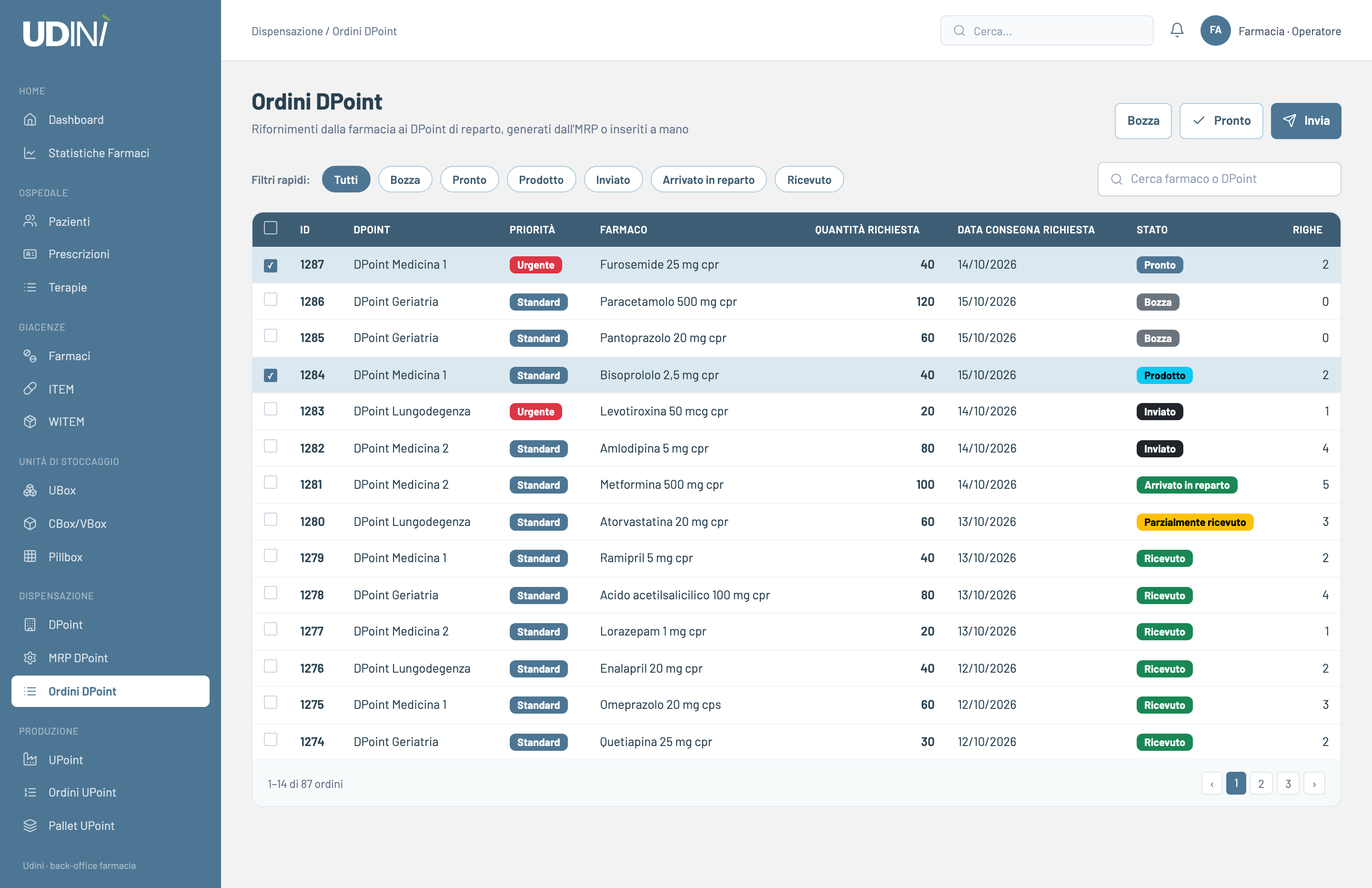
Order from pharmacy to ward
- Draft
- Ready
- Produced
- Sent
- Arrived at ward
- Received
Traceability
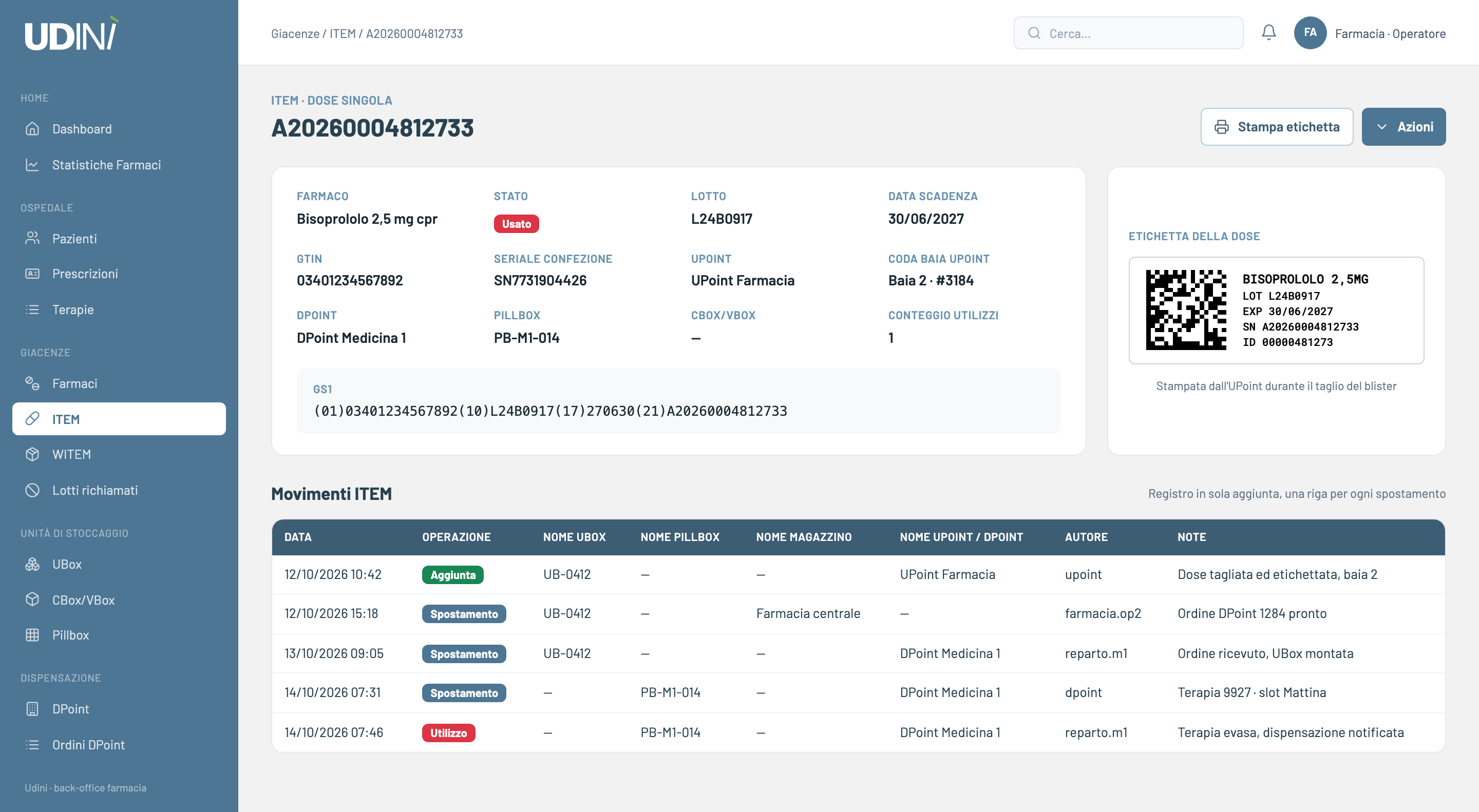
The full story of every single dose
Each dose has its own GS1 code with batch and expiry, plus a movement log: cut in the pharmacy, moved to the ward, placed in the pillbox, administered. When a batch is recalled, the affected doses can be located at once.
Features
What the system does
- Cutting and labelling
- Blisters turned into single doses, each with a GS1 DataMatrix: drug, batch, expiry, serial.
- Pillbox dispensing
- The DPoint fills each patient’s pillbox by time slot, with up to five configurable slots.
- Assisted picking
- Side drawers unlock and a light shows the nurse what to pick.
- Prescription validation
- Flags missing drugs, code conflicts or shortages and suggests equivalents.
- Planning and replenishment
- Hourly production and ward replenishment proposals.
- Per-dose traceability
- Movement log for every dose, box, UBox, drawer and pillbox.
- Batch recall
- Finds a batch across all stock and blocks the doses to recall.
- Electronic labels
- E-ink tags on pillboxes and drawers with patient, ward and bed; reprints on Zebra printers.
- Inventory and statistics
- Real-time stock by warehouse and ward, per-drug statistics and an anomaly dashboard.
Thinking about automating a critical process like this one?
Next case
Port logistics · Certified weighing
VGM Management System